

Full disclosure: This post contains affiliate links. If you make a purchase through these links, 99signals may earn a commission at no additional cost to you.
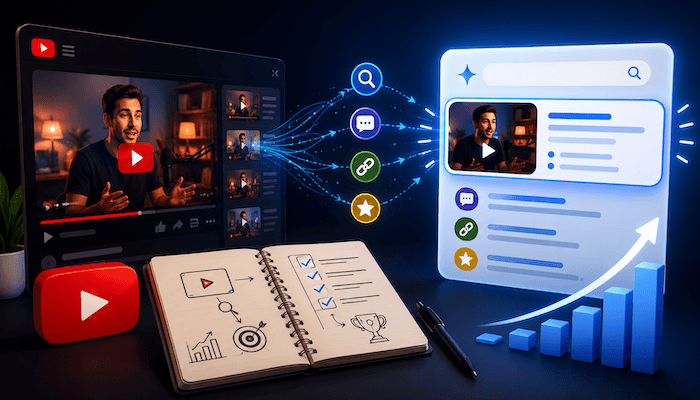
Most B2B marketing teams categorize YouTube as a brand awareness channel. It sits at the top of the funnel, it’s useful for reach, and it’s rarely connected to pipeline in any reporting that matters.
The data from the past few months makes that categorization difficult to defend.
Grizzle analyzed 3,623 SaaS YouTube videos across 873 queries, including 138 branded keywords with obvious purchase intent, terms like “hubspot vs salesforce” and “klaviyo alternatives.” YouTube was cited in the AI Overviews for 120 of those 138 keywords, roughly 87%.
Only 0.7% of those citations came from any of the 71 brand channels the study tracked. Sixty-one of those channels earned zero AI Overview citations across the entire dataset, and of the ten that appeared at all, nine earned five or fewer.
The channels absorbing those citations are independent creators and affiliates: HelperMan, Consumer Research Studios, Merchant Maverick. They’re producing content aligned with the queries buyers actually run, and AI systems are rewarding that alignment.
So AI is citing YouTube heavily when prospects research your category. It just isn’t citing you.
Why YouTube Correlates So Strongly With AI Visibility
Three separate findings explain why this channel matters more than most teams assume.
The first comes from Ahrefs, which studied 75,000 brands to identify what actually predicts AI brand visibility. Among every metric they measured, YouTube mentions showed the strongest correlation, ahead of link volume and total page count. Not backlinks. Not domain authority. YouTube presence.
The second comes from Foundation, which analyzed 8,566 keywords across 130+ SaaS categories and 14 domains. Across the full keyword set, the intent distribution looks unremarkable: 58.1% commercial, 23.3% informational, 11.5% transactional, 7.1% navigational.
Filtering to only the keywords where YouTube ranks in Google’s top 10 changes the picture substantially. Transactional keywords rise from 11.5% to 18.7%, and navigational keywords nearly triple, from 7.1% to 17.5%.
That distribution contradicts the awareness assumption directly. YouTube isn’t over-indexing on informational, early-stage queries. It’s over-indexing on the queries buyers run when they’re choosing between options.
The third finding is a leading indicator rather than a current-state measurement. Foundation tracked YouTube’s penetration rate by query length and found the curve dips through three- and four-word queries, where traditional blog content competes hardest, then climbs again: 13.4% at five words, 16.1% at six-plus words.
This matters because large language models run query fan-outs. A single conversational prompt expands into dozens of longer, more specific variations before the model assembles an answer. Those expanded queries are precisely where YouTube’s presence is strongest, which suggests its citation share is more likely to grow than shrink.
The Funnel Misclassification and What It Costs
The most common objection to YouTube investment is that video belongs at the top of the funnel. It builds familiarity, it’s hard to attribute, and the ROI case is weak compared to bottom-of-funnel content.
The SERP data undercuts that reasoning. When YouTube appears in Google’s top 10 at nearly double its baseline rate for transactional queries and nearly triple for navigational ones, it’s not occupying the awareness stage. It’s occupying the decision stage.
The downstream effect of the misclassification is predictable. Teams underinvest, produce video without search intent behind it, skip the metadata discipline they’d apply to any blog post, and then report negligible traffic and zero AI citations. The conclusion they draw is that video doesn’t work for them. The more accurate conclusion is that video produced without search intent doesn’t work, which is equally true of text.
The Compounding Disadvantage
There’s a timing problem layered on top of the strategic one.
YouTube videos cited in AI “best X” answers skew older, averaging around nine months. Citation positions accumulate authority the longer they hold, which makes them progressively harder to displace.
That creates a compounding disadvantage for brands sitting this out. Each quarter without a YouTube AEO strategy is another quarter where an affiliate’s comparison video deepens its hold on the answer AI gives your prospects.
Grizzle’s own read on their data is worth taking seriously here. They suggest the likeliest explanation for the brand-channel gap isn’t that AI systems deprioritize brand content, but that the brands they tracked were producing less content aligned with buyer queries and prompts in the first place.
That’s an encouraging diagnosis. It means the gap is a strategy problem rather than a structural bias. But it’s a diagnosis with an expiration date, because the positions keep hardening while the strategy problem goes unaddressed.
What Actually Drives YouTube Citations
YouTube AEO doesn’t require novel tactics. It requires applying the editorial discipline of text SEO to a medium most teams approach casually.
Speak your target phrases aloud in the video. AI systems cite transcripts, not titles or descriptions. If you want to be cited for a specific phrase, that phrase needs to appear in your spoken content, scripted deliberately. Metadata alone won’t produce the citation.
Treat the description as a structured summary. Description length shows a meaningful positive correlation with citation frequency. Aim for 300+ words covering the key points, the speaker’s credentials, and links to related resources, written for a system that needs to parse what the video contains.
Structure the video for extraction. Add chapter markers to anything over five minutes. Front-load the answer rather than building toward it. Correct auto-generated transcripts, because transcript errors become citation errors.
Target the query types creators are winning. Comparisons, “best X for Y” roundups, alternatives, and tutorials. These are the formats where AI provides direct recommendations, and they map to the transactional and navigational queries where YouTube over-indexes.
Build playlists as topic clusters. The same hub-and-spoke architecture that works for written content applies here. A pillar video covering your core category term, supported by videos addressing specific subtopics in depth.
How Semrush One Closes the YouTube AEO Gap
Everything above assumes you can see your own category clearly, and that’s where most teams stall.
Aggregate studies tell you YouTube drives AI citations across SaaS broadly. They don’t tell you which queries in your category surface video, whether your videos appear anywhere, which creators hold the positions you want, or whether a given position is contestable or effectively locked. Without that visibility, video production becomes an act of faith rather than a strategy.
This is the kind of gap Semrush One was built to close, and each toolkit maps to a specific part of the problem.
Keyword Research identifies where video over-indexes in your category. Foundation’s transactional and navigational findings describe their sample, not yours. Running your own keyword set through intent analysis surfaces the specific high-intent terms where YouTube content is competing in the top 10, which converts a vague mandate to “do more video” into a prioritized production list built around citation potential.
Position Tracking reveals the competitive reality. You can monitor where YouTube content appears in traditional results for your target queries, both your videos and everyone else’s, alongside the AI-generated answers for those same terms. This is how you distinguish an open position from one where a nine-month-old affiliate video has already accumulated the authority that makes it difficult to unseat.
AI Visibility Reports make the outcome measurable. Tracking brand mentions and citations across ChatGPT, Perplexity, Gemini, and Google AI Mode shows which prompts in your category surface video content and whether your brand appears in those answers or is absent from them. Given the Grizzle findings, most brands running this analysis will discover they’re among the 61 rather than the 10. That’s uncomfortable, but it’s the baseline you need before any of the tactical work has a way to prove itself.
Organic Research reverse-engineers the channels winning your citations. You can analyze competitor domains, including YouTube channel pages, to surface the keywords and content types driving their visibility. If an independent creator is absorbing the citations for your category’s comparison queries, this shows you which specific terms they’re winning and what format is doing the work.
The Content Toolkit handles the editorial layer. YouTube AEO succeeds or fails on the same rigor as text SEO: titles, descriptions, and topic alignment with search intent. The Content Toolkit applies content strategy discipline to your video metadata and to the supporting written assets, blog posts and landing pages, that reinforce your video content for AI retrieval.
The reason a bundled platform matters here more than usual is that YouTube AEO sits across two disciplines that are typically measured separately. It’s a search problem, evaluated in citations and rankings, and a content problem, evaluated in production quality and intent alignment. Running keyword research in one tool, AI citation tracking in a second, and competitive analysis in a third leaves you unable to connect video investment to visibility outcomes, which is exactly the gap that keeps YouTube stuck in the awareness column at budget time.
Semrush One offers a free 7-day trial with access to 55+ tools across the SEO and AI Visibility toolkits. That’s enough time to audit your category, identify which citation positions are genuinely contestable, and build a production list grounded in data before committing.
The Bottom Line
YouTube is the highest-leverage AI visibility asset most B2B teams are ignoring, and the reason they’re ignoring it is a funnel assumption that the SERP data contradicts.
The citations exist. They’re concentrated on the transactional and navigational queries where buyers make decisions. They’re going to independent creators who treated YouTube as a search engine while brands treated it as a content library.
Those positions compound, but they aren’t permanent. The gap between 61 brand channels earning zero citations and a handful of creators owning the category isn’t a competitive defeat. It’s an indication that almost nobody is competing yet.
Related Articles
The YouTube AEO framing is timely because video discovery is starting to depend on how clearly a clip can be understood and cited. An ai video generator can speed up testing hooks and explainers, but the content still needs the structured proof points you describe here.