

Full disclosure: This post contains affiliate links. If you make a purchase through these links, 99signals may earn a commission at no additional cost to you.
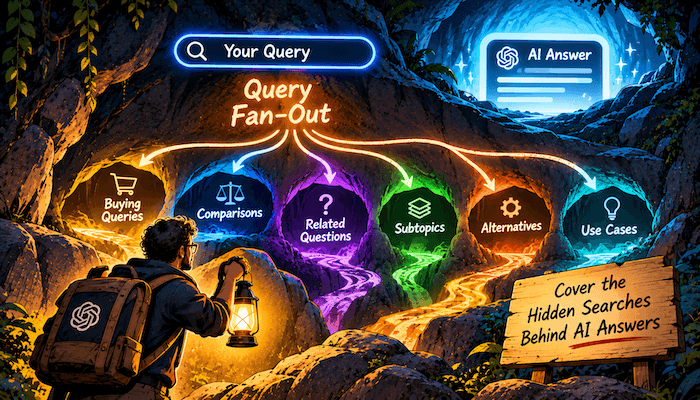
When someone asks ChatGPT or Google’s AI Mode for the best CRM for a 20-person sales team, the assistant usually doesn’t search that exact sentence. It breaks the question into narrower searches about pricing, integrations, reviews, and features, then assembles an answer from whatever those searches return.
That process is called query fan-out. Most marketers have heard the term by now, but very few have changed how they plan content or measure results because of it.
The gap matters because the searches doing the real work are almost invisible to standard SEO tools. If your content only targets the broad topic, you may never enter the pool of pages an AI assistant draws from, and nothing in your reporting will tell you why.
What Query Fan-Out Actually Is
Google described the technique publicly when it launched AI Mode in 2025. The system breaks a question into subtopics, runs many searches at once, and synthesizes the results into a single response.
ChatGPT, Gemini, Perplexity, and Claude all use versions of the same approach. The details vary by platform, but the pattern holds: one prompt in, several searches out.
On September 15, 2026, Google Research published a paper on a framework called R4T-Diffusion that makes this process much cheaper to run. Search Engine Journal’s coverage explains that it trains a small model to copy the fan-out behavior of a much larger one, producing a varied set of sub-queries without the usual delays.
According to the research, the new method runs 12 to 20 times faster than conventional fan-out. It was tested on fashion and music playlist data, though, and Google hasn’t announced it running inside Search.
So treat R4T-Diffusion as a signal of direction rather than a description of today’s AI Mode. When fan-out gets cheaper to run, search systems can afford to run more of it.
How Many Searches Sit Behind One Prompt
The number depends heavily on the platform, the model version, and the topic. Several independent datasets give a useful picture.
Peec analyzed more than 20 million ChatGPT fan-out queries and found their average length doubled from about six words in October 2025 to about twelve by January 2026. The number of fan-outs per prompt stayed steady at around two to three during that period.
Then GPT-5.6 changed the picture. Chris Long at Nectiv compared roughly 4,000 prompts on the new model against his 2025 baseline and found average fan-out queries per prompt rose from 2.17 to 7.61, with the longest chain growing from 4 searches to 29.
Google’s systems tend to go deeper. Nectiv’s research has Gemini averaging around nine fan-out queries per prompt, and in Google’s results, software prompts averaged 11.7 fan-outs, travel 10.8, and local searches just 3.79.
Not every prompt triggers a search at all. In Nectiv’s earlier testing, ChatGPT ran a live web search for only about a third of commercial prompts and answered the rest from what the model already knew.
That means two separate things decide whether you appear: what the model learned during training, and what its live searches find. Fan-out coverage only addresses the second, which is still a large share of commercial queries in categories like software.
What Fan-Out Queries Actually Look Like
The most important finding about fan-out queries is how little they resemble the keywords most teams target. Nectiv and the agency 85sixty separately found that about 95% of fan-out phrases show zero monthly search volume.
That makes them invisible to standard keyword research. A tool built on search volume data will never surface a twelve-word query that nobody types into Google directly.
The content of these queries is more predictable than their wording, though. In Nectiv’s analysis of ChatGPT fan-outs, “reviews” was the most common term by a wide margin, followed by the current year, then features and comparisons.
Since GPT-5.6, ChatGPT has also leaned heavily on terms like “site:,” “official,” and “gov,” which scope its searches to specific domains it already trusts. We covered how that shift hit Reddit’s visibility in our piece on ChatGPT and Reddit citations.
Put together, fan-out queries tend to be specific attribute searches. They ask about reviews, current-year information, features, pricing, and comparisons, often on official or established sources.
Why Ranking for Fan-Out Queries Isn’t Enough
A popular conclusion in SEO circles is that ranking for fan-out queries will reliably earn AI citations. Grow and Convert tested that idea, and the results are more complicated.
The agency ran 100 buying-intent prompts, captured the fan-out queries ChatGPT generated, and compared the sources it cited against Google and Bing results for those same queries. Only 27% of cited sources ranked on Google for the fan-out queries, and 23% on Bing.
About 60% of cited sources didn’t appear in the first ten pages of Google or Bing for those queries at all. Physical product prompts showed the lowest overlap, likely because ChatGPT draws on shopping data the study didn’t capture.
There’s an important caveat. The study could only see fan-outs that ran in the browser, and ChatGPT likely runs additional searches on OpenAI’s servers that outside observers never see.
Even so, the practical lesson is clear. Covering the sub-queries gets your content into consideration, but citation also depends on brand familiarity, source trust, and what the model already knows about your category.
How to Map the Fan-Out Behind Your Buyer Prompts
Mapping fan-out starts with buyer prompts rather than keywords. The goal is to see the full set of sub-questions an AI assistant asks on your buyer’s behalf.
Start with prompts grouped by topic. List the questions your buyers would actually ask an AI assistant, such as comparisons, “best tool for” questions, and use-case questions. Group them by topic, since many different phrasings lead to similar fan-outs.
Watch real fan-outs on your own prompts. Free browser extensions, such as Resoneo’s ChatGPT plugin, show the background searches ChatGPT runs for prompts you enter yourself. Run your most important buyer prompts a few times each, since results vary from run to run.
Mine Google Search Console for conversational queries. Chris Long suggests filtering your queries for ten or more words with the regex ^(?:\S+\s+){9,}\S+$. Long, natural-language queries in your data are a strong hint about the sub-questions people and AI systems are actually searching.
Group the sub-queries into dimensions. Most fan-outs for a commercial prompt fall into a handful of buckets: pricing, integrations, security, reviews, comparisons, specific use cases, and current-year information. Those dimensions become your coverage map.
Audit your coverage dimension by dimension. For each one, identify which page answers it, whether the answer is stated explicitly, and whether it’s current. Gaps usually cluster around pricing details, integration specifics, and anything with a date attached.
How to Build Content That Covers the Sub-Queries
Once you know which dimensions you’re missing, the work is mostly about making specific answers easy to find on the right pages.
Put attribute answers on official pages. Pricing, documentation, integrations, and security pages are exactly where “official” and “site:” searches land. If those pages are thin, gated, or vague, you’re missing the sources fan-out increasingly targets.
Answer each dimension explicitly. Use headings that match the sub-question, then state the answer directly underneath. A page that says “integrates with the tools you already use” answers nothing, while a page listing named integrations answers the actual fan-out.
Keep dates honest and current. Since the current year is one of the most common fan-out terms, outdated pricing or “2024” in a title works against you. Update the content itself, not just the date stamp.
Make sure reviews exist where AI looks. “Reviews” leads ChatGPT’s fan-out terms, so third-party reviews of your product need to exist on sites the assistant actually searches. Your own testimonials page won’t satisfy that sub-query.
Avoid a separate page for every sub-query. Hundreds of thin pages, one per fan-out variation, recreate the scaled content pattern that core updates keep penalizing. Fewer, stronger pages that cover several related dimensions well are the safer approach.
How to Measure Fan-Out Coverage Without Fooling Yourself
Measurement is where most teams go wrong, because single-prompt tracking badly understates the problem. Chris Long has pointed out that tracking 100 prompts properly could mean tracking 600 to 1,000 variations to account for how fan-out treats each one.
Track topics alongside individual prompts. A topic-level view shows whether you appear across the range of ways buyers ask the same question. Single prompts tell you about one phrasing on one day.
Separate citations from brand mentions. A page can be cited without your brand being named, and the reverse also happens. The two outcomes need their own lines in your reporting.
Watch trends over weeks, not single runs. AI answers vary between runs, so one check can mislead in either direction. Several weeks of consistent data is far more reliable than any single snapshot.
Where the Semrush AI Visibility Toolkit Fits

You can watch fan-outs for a dozen prompts in a browser, but every category has thousands of ways to ask the same question. Scale is the hard part, and it’s where manual methods break down.
The Semrush AI Visibility Toolkit is built around that scale problem, and each piece lines up with a stage of the work above.
Prompt Research draws on Semrush’s database of more than 317 million AI prompts across Google AI Overviews, AI Mode, Gemini, and ChatGPT. It reports volume at the topic level, which is how fan-out actually behaves, and shows which brands and domains already appear for each topic.
That topic-level view directly addresses Chris Long’s 600-to-1,000-variations problem. Instead of guessing which phrasings matter, you see the cluster of prompts and questions people actually ask in your category.
Prompt Tracking monitors your chosen prompts daily across ChatGPT Search, AI Mode, AI Overviews, and Gemini. Tracking several phrasings of the same buyer question shows whether your coverage holds up across variations or only appears for one wording.
Citations reports show which URLs get cited, the grounding queries associated with those citations, and citation counts by platform. It isn’t a complete list of every fan-out search, but it’s the closest view of which searches are leading AI systems to your pages.
Competitor Research surfaces prompts where competitors appear and you don’t. Those gaps usually point straight at the sub-question dimensions your content isn’t covering yet.
For the content side, Semrush’s SEO Toolkit adds Keyword Magic Tool’s question filters and Topic Research. Both help you find the specific subtopics a broad prompt is likely to break into.
The AI Visibility Toolkit costs $99 per month per domain on annual billing, with 25 custom prompts tracked daily, Brand Performance for one domain, mentions across ChatGPT, Google AI, Gemini, and Perplexity, competitor analysis, prompt research, and an AI readiness site audit. Since fan-out tracking pushes prompt counts up quickly, the 50-prompt add-on at $60 per month is worth factoring in.
Prompt Tracking is currently available in the United States, the United Kingdom, Canada, Australia, Spain, and India. The toolkit doesn’t offer a free trial, but the SEO + AI Search plans include AI visibility tracking and do come with one.
Explore the Semrush AI Visibility Toolkit
Final Thoughts
Query fan-out turns every buyer prompt into a set of narrower searches, most of which have no search volume and never show up in a keyword tool. The data so far shows those searches growing longer, more numerous, and more focused on official and trusted sources.
The practical response is to map the sub-questions behind your most important prompts, answer them explicitly on the right pages, and measure coverage at the topic level. Ranking for the broad term alone leaves too many of those searches unanswered.
Covering the sub-queries won’t guarantee a citation, as the Grow and Convert data makes clear. It does make sure your content is in the room when the AI decides what to say, which is the part of the process you can actually control.