

Full disclosure: This post contains affiliate links. If you make a purchase through these links, 99signals may earn a commission at no additional cost to you.
For two years, marketers have been asking Google for one thing: data on how their content performs inside AI Overviews and AI Mode.
On June 3, 2026, Google delivered. Sort of.
Google launched dedicated Generative AI performance reports in Search Console, breaking out impressions from AI Overviews, AI Mode, and Discover’s AI features into a standalone view for the first time.
The catch became obvious within hours of the announcement. The report shows impressions and nothing else.
No clicks. No click-through rate. No query data. No brand mentions. Just a count of how often your URLs appeared inside an AI feature, broken down by page, country, device, and date.
If you’ve been in SEO long enough, this should feel familiar. We’ve been here before.
What the Report Actually Shows
Let’s be precise about what shipped, because the gap between what marketers wanted and what they got is the whole story.
The Search Console Generative AI report gives you five dimensions, straight from Google’s documentation: impressions, pages, countries, devices, and dates.
Impressions count how often links to your site appeared in a generative AI feature.
Pages shows which of your URLs surfaced inside AI features.
Countries breaks visibility out by where the search originated.
Devices shows what people were using when your content appeared.
Dates tracks performance over time, down to hourly granularity.
That’s the entire feature. The data appears to start from May 18, 2026, with no historical backfill, and the rollout is limited to a subset of UK website owners first, tied to regulatory pressure from the UK’s Competition and Markets Authority, before any global release.
When Search Engine Land asked Google directly about click data, a spokesperson said the company is “continuing to work with website owners to understand what insights will be most helpful” and will “introduce additional metrics over time.”
Translation: clicks aren’t coming soon, and there’s no committed timeline.
Why Impressions Alone Don’t Solve the Problem
An impression tells you that you appeared. It tells you nothing about what that appearance was worth.
In traditional search, an impression without a click is a near-miss. You ranked, but nobody chose you. The click is where the value lives.
AI search breaks that logic in a way that makes impressions even harder to interpret.
When your page is cited in an AI Overview, the user often gets their answer directly from the summary without ever clicking through. The impression happened. The value transfer is invisible. You might have shaped the user’s decision, informed their next purchase, or built brand familiarity, and none of it shows up as a measurable outcome.
So now you have a metric that tells you that you’re appearing, in a context where appearing doesn’t reliably produce a click, with no data on whether the appearance influenced anything.
You’re left with proof that you showed up and no way to know if showing up mattered.
We’ve Seen This Movie Before
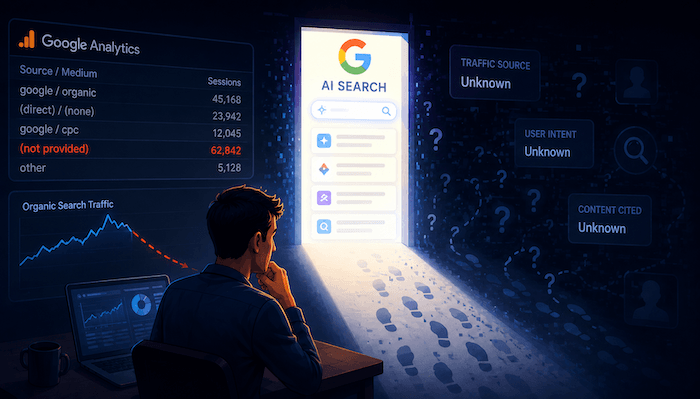
Here’s where the “not provided” parallel becomes useful.
Back in 2013, Google stopped passing keyword data for organic searches, replacing the actual search terms in analytics with the infamous “(not provided)” label. Overnight, marketers lost visibility into which keywords were driving their organic traffic.
The industry didn’t get that data back. Instead, it adapted.
Third-party tools got better at estimating keyword performance. Search Console eventually surfaced query data (with sampling and thresholds). Marketers built directional measurement frameworks that worked around the gap rather than waiting for Google to fill it.
The AI search report is the same pattern, starting over.
Google has given marketers a partial first-party signal. It’s useful, but it’s deliberately incomplete. And just like the “not provided” era, the gap won’t be filled by Google handing over complete data. It’ll be filled by third-party tools and smarter measurement frameworks that connect the dots Google won’t connect for you.
The marketers who adapted fastest in 2013 didn’t wait. The same will be true now.
The Real Measurement Gap
Strip it down and the GEO measurement problem has three layers Google’s report doesn’t touch.
You can’t see the queries. The report shows that you appeared, but not what prompt or question triggered the appearance. Without the query, you can’t optimize for it, can’t understand intent, and can’t build a content strategy around what’s actually surfacing you.
You can’t see beyond Google. Search Console only covers Google’s AI surfaces. It says nothing about ChatGPT, Perplexity, Gemini as a standalone product, or any other AI platform where your brand might be cited or ignored. For a measurement discipline that’s supposed to span every AI surface, that’s a significant blind spot.
You can’t see the competition. The report shows your impressions, not your share of voice. You have no idea whether competitors are being cited more often, in better contexts, or for the queries that matter most in your category.
Google was never going to solve all three. First-party tools answer first-party questions. The competitive and cross-platform layers were always going to require something else.
How to Build a Complete GEO Measurement Stack
The practical response isn’t to dismiss Google’s report. It’s a genuine signal, and you should use it. The response is to treat it as one input in a larger framework rather than the whole picture.
Use the Search Console report as your Google AI baseline. If you have access, start tracking which of your pages earn AI impressions and how that trends over time. Read it as a resonance signal: a page earning heavy AI impressions is content Google’s models find worth citing. That’s directionally valuable even without clicks.
Pair it with GA4’s AI Assistant channel for the click side. Google’s recently launched AI Assistant channel in GA4 captures referral traffic from AI tools. Cross-reference the impression data in Search Console against the click data in GA4 to approximate what your AI visibility is actually worth.
Add cross-platform and competitive visibility tracking. This is the layer neither Google tool covers, and it’s where a dedicated GEO tool earns its keep. This is the kind of gap Semrush One was built to close. Its AI Visibility toolkit tracks brand citations and mentions across ChatGPT, Perplexity, Gemini, and Google AI Overviews in one place, while the competitive research tools show where your rankings diverge from your AI citations and where competitors are winning visibility you’re not.
The combination matters because the same content quality signals that earn Google AI impressions increasingly determine whether you get cited across every other AI surface too. Seeing them together is the only way to know whether you’re winning or just appearing.
Semrush One offers a free 7-day trial with access to 55+ tools if you want to build out the full measurement stack before committing.
The above link is an affiliate link, which means 99signals earns a commission if you sign up through it. This doesn’t cost you anything extra, and it doesn’t influence what I recommend. I’ve been covering
Watch the broader trend, because this is becoming table stakes. The same week Google shipped its report, Microsoft confirmed more AI performance reporting is coming to Bing Webmaster Tools. Every major search platform is going to ship its own AI impression view in 2026. The fragmentation that creates is exactly why a unified measurement layer matters more, not less.
The Bottom Line
Google’s AI search report is a real step forward. For two years, marketers had to estimate their AI visibility using third-party tools and inference. Now they have a first-party signal directly from the source.
But a signal isn’t an answer. Impressions tell you that you exist in AI search. They don’t tell you what that existence is worth, what triggered it, how you compare to competitors, or what’s happening on the AI platforms Google doesn’t own.
The measurement gap didn’t close on June 3. It just got better documented.
And much like the “not provided” era, the teams that win won’t be the ones waiting for Google to hand over the complete picture. They’ll be the ones who built a framework that works without it.
Related Articles