


Full disclosure: This post contains affiliate links. If you make a purchase through these links, 99signals may earn a commission at no additional cost to you.
A pattern is showing up across SEO teams that breaks a two-decade assumption. Brands ranking first on Google for their core terms are being omitted entirely from ChatGPT, Gemini, and Perplexity answers about those same terms.
The page wins the search result. The brand loses the AI answer. Same query, opposite outcome.
The reason isn’t a content quality problem, and rewriting the page usually doesn’t fix it. It’s that AI systems and traditional search evaluate your brand in fundamentally different ways, and most teams are still optimizing for only one of them.
The Unit of Optimization Is Shifting From the Page to the Entity
Traditional SEO optimizes pages. You target a keyword, structure a page around it, earn links to it, and Google ranks it. The page is the unit of work.
AI systems don’t work that way. Before an LLM decides whether to mention your brand, it has to resolve you as an entity, a distinct, identifiable thing it can reason about, with attributes it can trust. Founders, category, products, location, associations. The question the model answers first isn’t “does this page match the query?” It’s “do I know who this brand is, and can I trust what I know?”
That resolution doesn’t happen on your website. It happens across the web.
When an AI system processes a query about your category, it runs named-entity recognition and entity linking, resolving mentions to a unique node in a knowledge graph. That node carries every fact the system has accumulated about you from every source it has read. Your own site is a small fraction of that picture. McKinsey’s 2025 estimate puts a brand’s own website at just 5 to 10% of what these systems read.
Which means 90% or more of how AI understands your brand is built from sources you don’t own.
Why AI Treats Your Website as a Claim, Not a Fact
This is the conceptual shift that reorganizes everything else.
Everything on your domain, your about page, your schema markup, your structured data, is treated by AI systems as an assertion. It’s what you say about yourself. Assertions require corroboration before a model will treat them as fact.
AI systems score entity confidence based on how many independent, trusted sources assert the same thing. When your website says you serve enterprise fintech clients, that’s a claim. When G2, Crunchbase, three industry publications, and a dozen community discussions independently confirm it, that’s a fact the model can cite with confidence.
The data behind this is striking.
That correlation gap explains the ranking paradox directly. You can hold the number one organic position through classic on-page and link signals while remaining invisible in AI answers, because the AI is reading corroboration across sources your SEO strategy never touched.
Independence matters as much as volume here. Fifty placements from the same content network read as one source repeating itself. Five genuinely independent mentions from unrelated trusted platforms carry more weight than the fifty. AI confidence is built on consensus among sources that don’t share an origin.
The Accidental Brand Problem
Here’s the part that makes this urgent rather than theoretical.
AI systems will describe your brand whether you manage the process or not. The question isn’t whether they’ll talk about you. It’s whether they’ll get you right.
Teams are discovering that LLMs surface incorrect service areas, outdated positioning, wrong product descriptions, and in some cases resolve the brand into the wrong entity node entirely, confusing it with a similarly named company. These errors don’t come from malice or a bad algorithm. They come from a scattered web of references that no longer matches the brand’s current reality, and an AI doing its best to assemble a coherent picture from inconsistent inputs.
If your G2 profile describes an old positioning, your Crunchbase entry lists a former product line, your LinkedIn says one thing and your homepage says another, the model has to reconcile contradictory claims. Sometimes it picks wrong. Sometimes it hedges by omitting you. Sometimes it hallucinates a resolution that satisfies none of the sources.
The brand never sees this happening, because it doesn’t show up in rankings, in Google Analytics, or in any dashboard built for the page-optimization era.
Corroboration Is the New Link Building
The strategic reframe is that third-party mentions, reviews, and press coverage are replacing backlinks as the currency of authority, and the mechanics of earning them are different.
Two things matter that didn’t matter for links.
The first is consistency. Your entity needs the same name, the same core description, and the same defining attributes across every platform where you appear. Google Business Profile, G2, Capterra, Crunchbase, LinkedIn, YouTube, industry directories. Inconsistency across these isn’t a minor hygiene issue anymore. It’s the thing that lowers an AI’s confidence in resolving you at all.
The second is recency. AI systems weigh how recently you mattered, not how big you used to be. A brand that was prominent three years ago but has gone quiet loses corroboration strength to a competitor generating fresh, consistent mentions now. This is a meaningful departure from the backlink model, where old links retained value for years.
Competitors who understand this are already rewriting their G2 and Capterra profiles specifically for how AI systems extract and corroborate facts. The entity positioning in most categories is being established right now, and it’s easier to claim an entity position than to displace one that’s already corroborated.
How to Audit and Fix Your Entity Presence
The work here splits into two halves: seeing how AI currently describes you, and fixing the underlying signals that description is built from. Most teams have tooling for neither.
This is the kind of gap Semrush One was built to close, and each toolkit maps to a specific stage of the entity workflow.
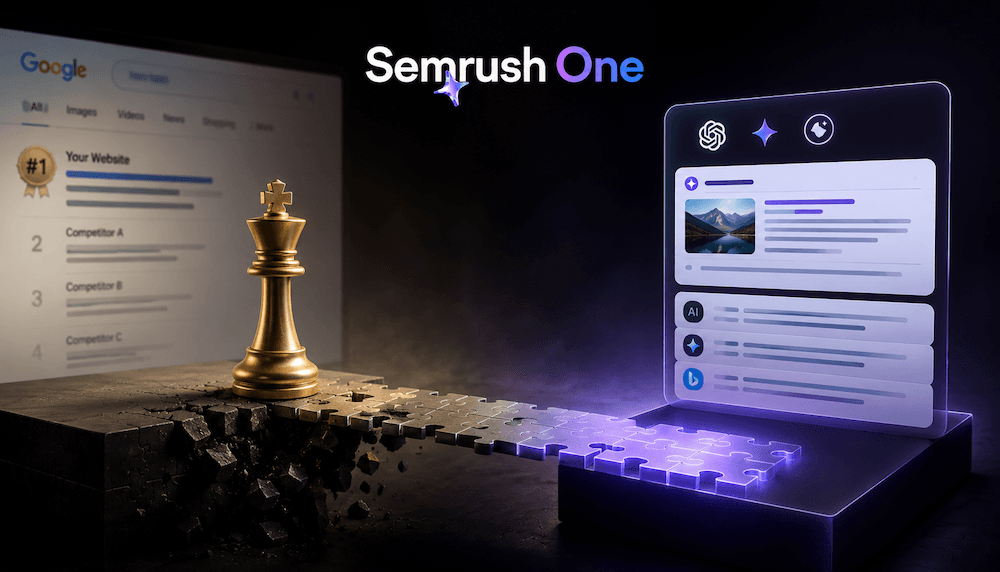
AI Search Tracking shows you what AI actually says. Monitoring how and where your brand appears across ChatGPT, Perplexity, Gemini, and Google AI Mode surfaces the mischaracterizations and omissions that need correcting. This is the diagnostic layer, and it’s the one most teams are completely blind on, because the errors never appear in any traditional report. You can’t fix a wrong service area or a missing mention you don’t know exists.
Position Tracking quantifies the gap. Running keyword rankings alongside AI citation presence for the same queries shows you exactly where you win the SERP but lose the AI answer. That gap is the entire thesis of this shift made measurable, and it’s the number that justifies redirecting effort toward entity work.
Brand Monitoring maps your corroboration footprint. Tracking brand mentions across the web identifies which third-party sources are currently shaping your entity profile and, critically, where they contradict each other. Since inconsistency across independent sources is what lowers AI confidence, finding those contradictions is the first concrete step toward fixing them.
Site Audit validates the signals AI extracts. While your own site is only a fraction of what AI reads, it’s still the anchor for structured data and schema that feed entity extraction. Site Audit evaluates your structured data implementation and schema accuracy, making sure the assertions on your own domain are clean and machine-readable before you work on corroborating them elsewhere.
Organic Research reveals where rivals are winning corroboration. Analyzing which competitor domains appear in both organic results and AI answers shows you where entity corroboration is giving them an advantage you’re not contesting. It turns a vague sense that competitors are “ahead in AI” into a specific list of the sources and topics where they’ve locked in positioning.
Traffic Analytics prioritizes which off-site presences to fix first. Estimating competitor traffic by source reveals which third-party platforms, review sites, directories, and publications drive the most visits in your category. Those high-traffic external surfaces are also the ones most likely to carry entity-corroboration weight, which tells you where to invest first rather than trying to fix every platform at once.
The reason a single platform matters for this particular problem is that entity work is only legible in the connection between what AI says and what the web is telling it. Seeing your AI characterization in one tool and your web mentions in another leaves the causal link, the specific inconsistency producing the specific error, invisible.
Semrush One offers a free 7-day trial with access to 55+ tools across the SEO and AI Visibility toolkits, which is enough time to run a full entity audit and identify where your corroboration gaps are before committing.
The Bottom Line
The shift from page optimization to entity corroboration isn’t a new tactic layered on top of SEO. It’s a change in what the unit of optimization is.
For twenty years, the answer was the page. You made a page, ranked it, and traffic followed. That still works for traditional search, and traditional search still drives most measurable traffic, so none of this is an argument for abandoning it.
But AI discovery runs on a different question. Not “is this page relevant?” but “do I know who this brand is, and do enough independent sources agree?” A brand can win the first question decisively and lose the second without ever realizing the second question was being asked.
The brands that get this right won’t be the ones with the best schema markup. They’ll be the ones whose identity is described consistently, accurately, and recently across the independent sources AI systems actually read.
Related Articles