

Full disclosure: This post contains affiliate links. If you make a purchase through these links, 99signals may earn a commission at no additional cost to you.
Sam Altman spent years positioning advertising as the last thing OpenAI would ever do. Then, on January 16, 2026, he announced ChatGPT would start serving ads.
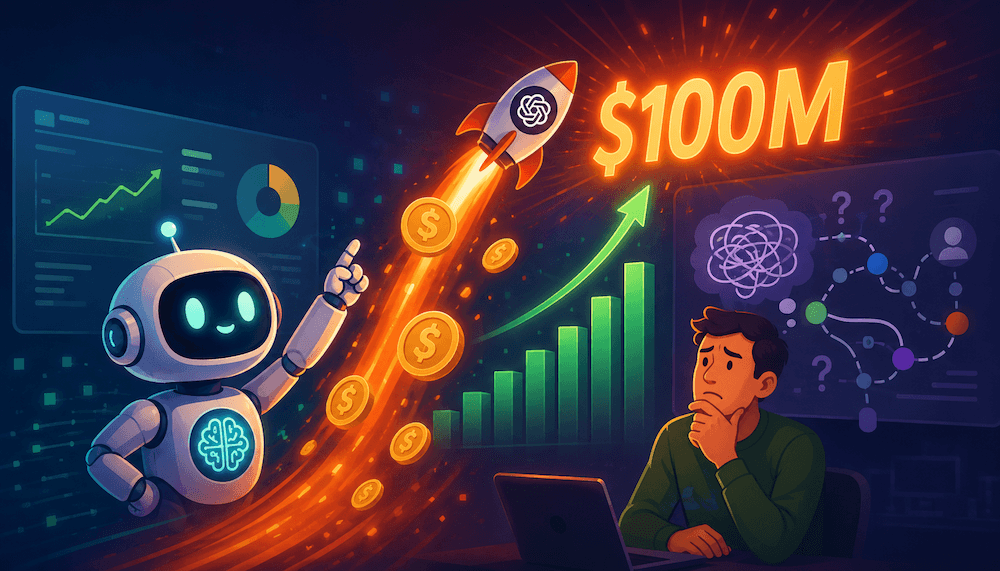
Six weeks later, the pilot had crossed $100 million in annualized revenue.
By April, CPC bidding was live. By May, OpenAI had inked partnerships with Criteo, Adobe, WPP, and Publicis Groupe, with a long-term projection of $100 billion in ad revenue by 2030.
The leadership hires tell you everything about how seriously OpenAI is treating this.
Fidji Simo, former CEO of Instacart, now runs OpenAI’s applications division. Denise Dresser, former Slack CEO, came on as chief revenue officer in December 2025. David Dugan, who spent over a decade leading Meta’s global advertising solutions, was brought in to build the ads team in March 2026.
That’s not the hiring profile of a company running a test. That’s the hiring profile of a company building a permanent revenue engine.
For marketers, this creates two problems landing simultaneously: a new advertising channel that operates on completely different mechanics than anything they’ve used before, and a measurement framework that’s cracking under the weight of zero-click research behavior.
How the Money Is Actually Moving
The speed of advertiser adoption here is unlike anything since the early days of programmatic.
OpenAI’s ads pilot drew more than 600 advertisers in its first six weeks, during a phase when the minimum buy-in was $200,000.
That’s not small businesses experimenting with spare budget. That’s major brands committing serious money to an unproven channel because the audience numbers are impossible to ignore.
ChatGPT now has over 900 million weekly active users and more than 50 million consumer subscribers.
The pricing evolution has been rapid. Launch CPMs sat around $60, roughly three times what Meta charges and comparable to premium broadcast inventory. Within nine weeks, CPMs had dropped to around $25 as inventory expanded and OpenAI introduced CPC bidding to attract performance-focused buyers.
The conversion data backing up those prices is compelling. Criteo analyzed 500 U.S. retailers in February 2026 and found that users arriving from LLM platforms convert at roughly 1.5 times the rate of other referral channels. Higher intent, higher conversion, premium pricing.
The advertiser value proposition writes itself, even with immature measurement infrastructure.
And here’s the detail that matters most for scale: roughly 85% of ChatGPT’s free and Go users qualify for ad exposure, but fewer than 20% see ads on any given day.
OpenAI is monetizing a sliver of its available inventory. As ad load increases, the revenue trajectory steepens dramatically.
Why This Isn’t Just Another Ad Platform
Most early coverage of ChatGPT ads treats them like a new tab in your Google Ads dashboard. That framing will lead you to the wrong strategy, the wrong budget allocation, and the wrong expectations.
There are no keywords to bid on
ChatGPT’s ad system matches brands to conversations based on topical context, chat history, and previous ad interactions rather than keyword auctions.
You’re not buying placement against “best CRM software.”
You’re matching against the shape of an entire research conversation.
The targeting logic sits somewhere between contextual display and search intent, but with richer signals than either one offers independently.
You get exclusive attention when you show up
Each ChatGPT response serves a single ad placement. There’s no auction for position one versus position four. No sidebar competition. No organic results pushing your paid placement below the fold.
When your brand appears, it has the user’s full commercial attention within that response, a dynamic that doesn’t exist anywhere in traditional search advertising.
The exposure persists across the conversation
Research referenced in
That’s a structurally different attention model than impression-based media.
The 83% invisible funnel
According to the
This is the most important number in the entire ChatGPT ads story.
It means there’s an entire layer of commercial intent, comparison research, category exploration, problem framing, that traditional paid search has never been able to reach.
ChatGPT ads don’t compete with Google Ads for the same queries. They access queries that Google Ads can’t see.
The Attribution Crisis Nobody’s Solved
This is where the gold rush narrative hits a wall, and where the real strategic challenge lives for marketing teams.
When a user asks ChatGPT “what’s the best project management tool for a remote team of 15,” sees an ad for Monday.com, continues the conversation for six more turns exploring features and pricing, then opens a browser tab and signs up three days later through a branded Google search, who gets credit?
The honest answer: nobody, reliably.
ChatGPT’s ad measurement infrastructure is still early. OpenAI has rolled out a conversion tracking pixel and Conversions API, but the gap between “pixel fires on landing page” and “we understand the full journey from ChatGPT conversation to conversion” is enormous.
The user might convert days later. They might convert on a different device. They might convert after validation on Google, Reddit, and a G2 review page.
The ChatGPT ad was the catalyst, but the attribution model will credit the last touchpoint.
This isn’t a new problem in principle. Cross-channel attribution has been broken for years. But ChatGPT ads make it worse in two specific ways.
First, the research that happens inside ChatGPT is invisible to your existing analytics.
When a user spends twenty minutes asking ChatGPT about your category, comparing you to three competitors, and exploring pricing options, none of that shows up in your Google Analytics, your CRM, or your ad platform dashboards.
The most valuable part of the consideration journey is happening inside a black box.
Second, branded search impressions are declining as research behavior migrates to AI platforms.
Adobe’s recent AI traffic report found that 55% of shoppers now turn to AI for shopping inspiration and ideas. When a user who would have previously searched “Monday.com vs Asana” on Google now asks ChatGPT instead, your branded search volume drops.
Your Google Ads team sees declining impressions and doesn’t know why.
The demand hasn’t disappeared. It’s moved to a channel your measurement can’t see.
The First-Mover Window (And Why It’s Closing Fast)
As of March 2026, roughly 600 brands had entered OpenAI’s ads pilot.
Google Ads, by comparison, has millions of active advertisers.
That gap between 600 and millions is the opportunity, and it won’t last.
The dynamic is familiar to anyone who remembers what Google AdWords looked like in 2003, except this time the competition window is measured in months, not years.
OpenAI’s self-serve Ads Manager went live in May 2026, eliminating the $200,000 managed campaign floor that kept smaller brands out during the pilot phase.
Early CPC benchmarks sit between $3 and $5 per click, a fraction of what competitive Google Ads categories command in SaaS, financial services, or legal, where $20 to $50 per click is standard.
That pricing advantage has a shelf life. Performance budgets follow conversion data, and the conversion data here is going to pull serious spend onto the platform fast.
When major brands shift meaningful budgets to ChatGPT ads, the low-competition pricing environment disappears.
How to Get Started with ChatGPT Ads (Without Wasting Budget)
The honest truth about ChatGPT ads right now is that nobody has the playbook figured out, including the agencies charging you to figure it out. The smart move isn’t to wait for the playbook to exist. It’s to build small, learn fast, and avoid the mistakes that come from treating this like a familiar channel. Here’s where to start.
Test ChatGPT ads with a small budget now
The self-serve platform is live. Start with $500 to $1,000 in CPC campaigns targeting your core category conversations. The goal isn’t ROI on day one. It’s learning the mechanics, understanding the targeting, and building baseline data before the auction gets crowded.
Audit your AI visibility alongside your paid strategy
You can’t run ChatGPT ads intelligently if you don’t know how your brand appears organically in AI responses. If ChatGPT already recommends your competitor when someone asks about your category, your paid placement is fighting the platform’s own organic answer.
For this, Semrush One is the platform worth checking out because it bundles traditional SEO tracking with AI visibility reports across ChatGPT, Gemini, AI Overviews, and AI Mode.
You can see where your brand is being cited organically in AI responses, where competitors are winning, and where the gaps are, all in the same dashboard where you track your traditional search performance.
They offer a free 7-day trial with access to 55+ tools if you want to run the audit before committing.
Build a separate measurement framework for AI-originated demand
Don’t try to force ChatGPT ads into your existing Google Ads attribution model. Track branded search volume trends over time and correlate them with AI platform usage. Look for “last mile” conversions that originated in AI conversations but closed on your website through direct or branded search. Accept that the attribution will be imperfect and allocate budget based on directional signals rather than pixel-perfect ROAS.
Prioritize your organic AI presence first
Agency experts argue that establishing a generative engine optimization (GEO) strategy may be more valuable than buying ChatGPT inventory. This isn’t wrong. If your brand doesn’t exist in AI organic responses, you’re paying for attention in a context where the platform’s own answer doesn’t validate you. Fix the organic foundation first, then layer paid on top.
Watch the FOMO, but don’t dismiss it entirely
Several early advertisers admit it’s too early to point to meaningful returns. The honest assessment: ChatGPT ads are a legitimate new channel with real commercial potential, but the measurement infrastructure is immature, the creative formats are limited, and the optimization playbook doesn’t exist yet. Test it. Don’t bet the quarter on it.
The Bigger Picture
Sam Altman spent years calling advertising a “last resort” for OpenAI. The fact that it went from last resort to $100 million in six weeks tells you everything about the economics of running the world’s largest AI consumer product. OpenAI needs advertising revenue. That means the ad product will get better, the targeting will get sharper, the measurement will get more robust, and the inventory will expand.
For marketers, the question isn’t whether ChatGPT ads matter. It’s whether you build the muscle to operate across both traditional and AI-driven advertising surfaces before the window of low competition closes, or whether you wait until the playbook is written by your competitors.
The early Google Ads adopters didn’t have a playbook either. They had cheap clicks and the willingness to figure it out. The ones who moved early built advantages that lasted a decade.
The clock on this window started six weeks ago. It’s already ticking.
Related Articles