
Full disclosure: This post contains affiliate links. If you make a purchase through these links, 99signals may earn a commission at no additional cost to you.
For twenty-five years, “search” meant Google. If you wanted to be found online, you optimized for Google. If you wanted to measure discovery, you looked at Google. If someone said “search market share,” the answer was always somewhere north of 90%.
That number is wrong. Not because Google is shrinking (it isn’t), but because the definition of search was always too narrow.
In January 2026, Rand Fishkin and the team at Datos (a
The headline finding: Google handled 73.7% of all desktop searches across those 41 domains in Q4 2025. Not 90%. Not 95%. Seventy-three point seven percent.
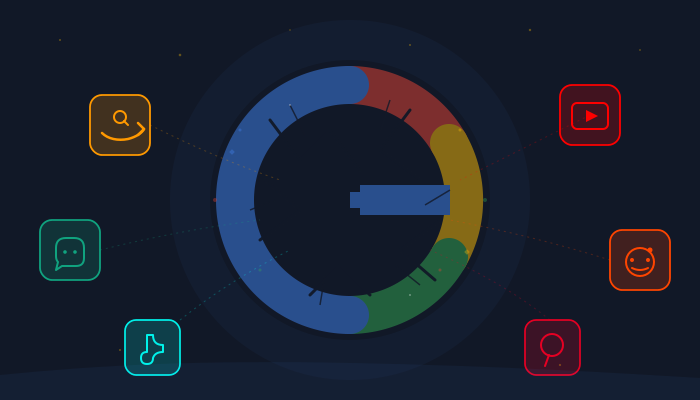
That remaining 26.3% isn’t noise. It’s Amazon, YouTube, Bing, ChatGPT, Reddit, TikTok, Pinterest, Wikipedia, and dozens of other surfaces where real people conduct real searches with real purchase intent. And most marketing teams have no systematic strategy for any of them.
Table of Contents
The 90% Myth and Where It Comes From
The widely cited “Google has 90%+ market share” figure comes from measurement firms like StatCounter, which only track traditional search engines. By that definition, Google does dominate overwhelmingly. Bing, Yahoo, DuckDuckGo, and Yandex collectively hold the remainder, and none of them matter much individually.
But that definition excludes everywhere else people search. It excludes the person searching Amazon for “wireless earbuds under $50.” It excludes the Gen Z user searching TikTok for “best skincare routine for oily skin.” It excludes the developer searching Reddit for “Next.js vs Remix 2026.” It excludes the shopper asking ChatGPT “compare Dyson V15 vs Samsung Jet 90 for pet hair.”
All of those are searches. All of them influence purchase decisions. None of them show up in the “Google has 90% market share” number.
Fishkin’s framing is worth internalizing: if ChatGPT counts as search, why doesn’t Instagram? If Perplexity is a search competitor, why isn’t YouTube? The moment you accept that search is any query a person makes to find information, products, services, or answers, the competitive landscape looks fundamentally different.
What the Data Actually Shows
The SparkToro/Datos breakdown of Q4 2025 U.S. desktop search activity, grouped by category, tells a story most marketing teams aren’t prepared for:
- Traditional search engines (Google, Bing, Yahoo, DuckDuckGo, etc.) account for roughly 80% of all search activity across the 41 platforms. Google alone holds 73.7%.
- Commerce platforms claim about 9.8%. Amazon is the standout here, with more search activity than ChatGPT. This is a point worth pausing on. Marketers are pouring resources into “how to rank in ChatGPT” while Amazon, a platform with explicit purchase intent behind every search, gets comparatively little attention from content and SEO teams.
- AI tools (ChatGPT, Gemini, Claude, Copilot, Perplexity, DeepSeek) account for roughly 3.2% of desktop search. Growing fast, but still a fraction of the attention they receive in marketing discourse.
- Social platforms (YouTube, Reddit, TikTok, Pinterest, Instagram, LinkedIn, X, Threads) collectively hold a meaningful share, with YouTube alone generating more search volume than most AI tools combined.
- The EU/UK numbers tell a similar story with some variation. Google holds about 78.5% in those markets (roughly 5 points higher than the U.S.), ChatGPT reaches 3.68% (slightly higher than its U.S. share), and Amazon sits at 5.35%.
A few data points from the study that deserve more attention than they’re getting:
- Amazon has more search volume than ChatGPT. Despite all the AI hype, the platform where people search with their wallets open still dwarfs every AI tool in raw query volume.
- Threads is growing remarkably fast. Searches per user on Meta’s Threads doubled over the course of 2025, from roughly 2 per user to nearly 4. This coincides with Threads surpassing X’s daily mobile user count in January 2026.
- Pinterest is quietly significant. Growing searches per user, high purchase intent, and an algorithm that makes organic visibility genuinely valuable for consumer-facing brands. Most marketing teams ignore it completely.
- 23 of the 41 platforms analyzed had more than 0.1% market share. If Google conducted 5 trillion searches in 2025, that 0.1% threshold equals 5 billion searches per year per platform. These aren’t rounding errors.
AI Joined the Search Stack (It Didn’t Replace It)
There’s a temptation to read the fragmentation story as “Google is dying.” It isn’t. Google processed more searches in 2025 than any prior year. The 73.7% figure looks lower than the traditional 90%+ only because we’re finally counting the other places where search happens. Google didn’t lose share to AI. The map got bigger.
But here’s what did change: AI is now part of the buyer journey in a way that can’t be dismissed as experimental.
A Semrush survey of 1,030 U.S. shoppers who have tried AI tools, published in March 2026, found that 43% have discovered a completely new brand through AI. Not just confirmed a brand they already knew. Discovered one they’d never heard of.
Other findings from the same survey worth noting: 48% of consumers who’ve tried AI use it daily. 55% use it specifically for product research at least weekly. 77% use AI and traditional search together (AI hasn’t replaced Google, it’s layered on top of it). And 22% have completed a purchase directly inside an AI tool.
The implication for marketers is that AI isn’t a separate channel you can ignore because “it’s only 3.2% of search.” It’s a layer that sits across the entire buyer journey, from discovery to consideration to purchase. Someone might discover you in ChatGPT, validate you on Google, read reviews on Reddit, and buy through your website. Or through Google’s new Universal Commerce Protocol without visiting your website at all (but that’s a different article).
The Attribution Problem Nobody Has Solved
Here’s where the fragmentation story gets genuinely uncomfortable for marketing teams.
When a buyer discovers your brand on TikTok, validates the recommendation on Reddit, gets a second opinion from ChatGPT, checks your pricing on your website, and converts through an email three weeks later, which channel gets credit?
The honest answer: nobody knows. No existing attribution model handles this journey. Last-touch gives all credit to the email. First-touch gives it to TikTok. Multi-touch distributes it across whatever touchpoints happened to be trackable, which excludes the Reddit thread and the ChatGPT conversation entirely.
This isn’t a measurement inconvenience. It’s a strategic problem. If you can’t attribute discovery to the channels where it actually happens, you can’t justify budget allocation to those channels. And if you can’t justify the budget, you keep over-investing in Google and under-investing in the 26.3% of search that happens everywhere else.
The CMO survey data referenced in industry discussions shows a 20x gap between what drives vendor consideration (word of mouth and peer recommendations) and where budgets concentrate (paid ads and SEO). That gap isn’t accidental. It’s a direct consequence of attribution models that can only see what’s easily measurable.
What to Actually Do About This
The worst response to this data is to panic and try to be everywhere simultaneously. The second worst response is to ignore it and keep treating Google as the only platform that matters.
The right response is strategic and specific to your audience.
1. Start with where your audience actually searches
The SparkToro data is a population-level view. Your audience isn’t the population. If you sell B2B SaaS, Reddit and LinkedIn might matter more than TikTok. If you sell consumer products, Amazon and Pinterest might matter more than ChatGPT. The study gives you the map. You need to figure out which part of the map your customers live on.
2. Audit your AI visibility
43% of consumers have discovered a new brand through AI. Are they discovering yours? You need to know whether your brand is being cited, recommended, or ignored when people ask ChatGPT, Gemini, or Perplexity questions in your category.
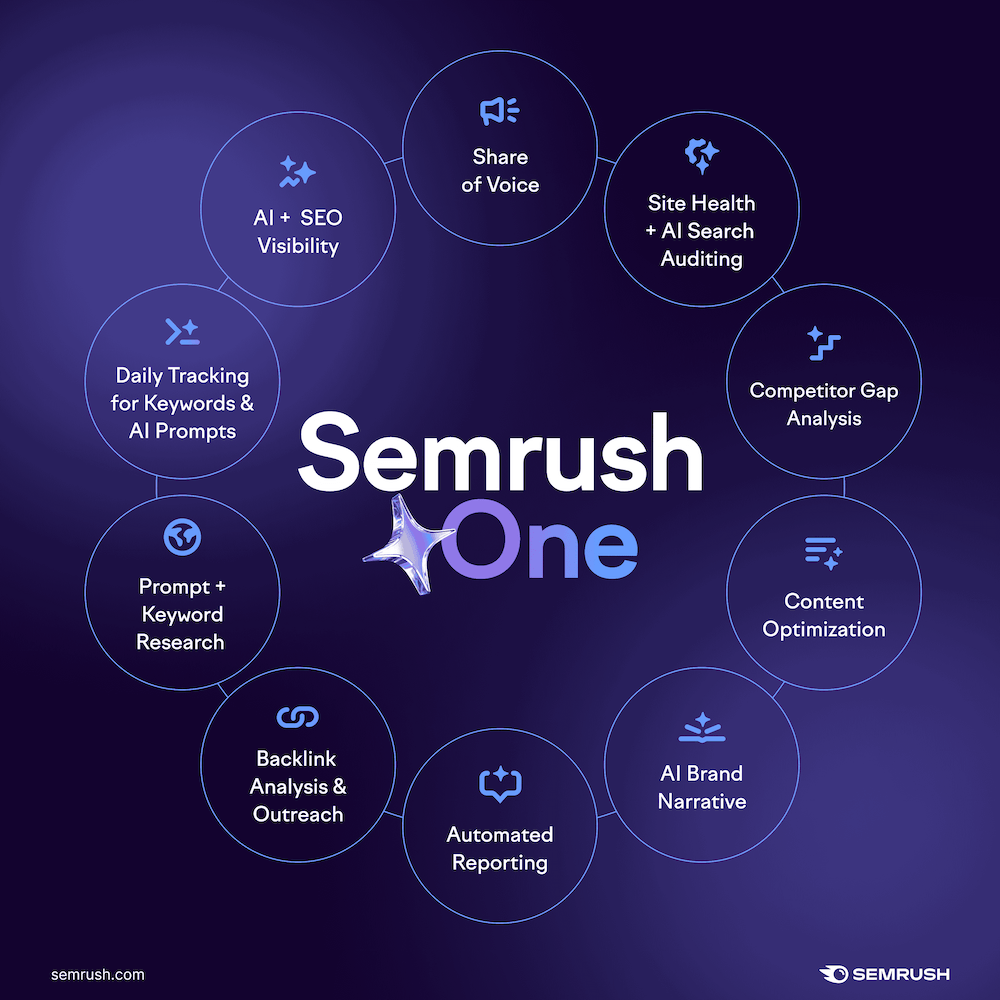
Semrush One is the tool I’d point you to here, specifically because it bundles traditional SEO tracking with AI visibility reports that show how your brand appears across ChatGPT, Gemini, Google AI Overviews, and AI Mode. Most tools do one or the other. This does both in the same dashboard.
Full disclosure: The above link is an affiliate link, which means 99signals earns a commission if you sign up through it. This doesn’t cost you anything extra, and it doesn’t influence what I recommend. I’ve been covering
3. Don’t abandon Google to chase AI hype
The data is clear: Google still handles nearly three-quarters of all search. AI tools are at 3.2%. The marketers rushing to “optimize for ChatGPT” at the expense of Google organic are optimizing for 3% and neglecting 74%. The smart play is to layer AI visibility on top of a strong Google foundation, not replace one with the other.
4. Invest in the platforms your attribution model can’t see
Reddit, word of mouth, community, podcast mentions, YouTube, niche forums. These are the channels where brand preference is formed before a search ever happens. You won’t be able to measure their impact perfectly. That doesn’t mean the impact doesn’t exist. The SparkToro data proves that a quarter of all search activity happens outside Google. Much of the influence that drives those searches happens in places that never show up in your analytics at all.
5. Watch the agent layer
This is the horizon bet. Autonomous AI agent frameworks are beginning to execute tasks, make purchases, and complete workflows without generating views, clicks, or ad impressions. When agents start making discovery and purchasing decisions on behalf of users, every metric we currently use to measure marketing performance becomes partially obsolete. We’re not there yet. But the infrastructure is being built now, and the marketers who understand it earliest will have the longest runway to adapt.
The Real Search Landscape Has Always Been This Big
The most useful reframe of the SparkToro/Datos research isn’t “search is fragmenting.” It’s that search was always fragmented. We just weren’t measuring it.
For two decades, “search market share” meant “search engine market share,” which meant Google had 90%+ and everything else was a rounding error. That measurement was accurate within its scope. It was just the wrong scope.
Now that we have data on where search actually happens, across 41 platforms, across every quarter of 2025, across millions of devices in the U.S. and EU/UK, the picture is different. Not because the landscape changed overnight, but because we’re finally looking at the whole landscape instead of one corner of it.
Google is still the biggest mountain in the range. It’s just not the only mountain. And the marketers who build their strategy for the entire range, not just the tallest peak, are the ones who’ll have the widest visibility when their buyers go looking.
Related Articles