
Full disclosure: This post contains affiliate links. If you make a purchase through these links, 99signals may earn a commission at no additional cost to you.
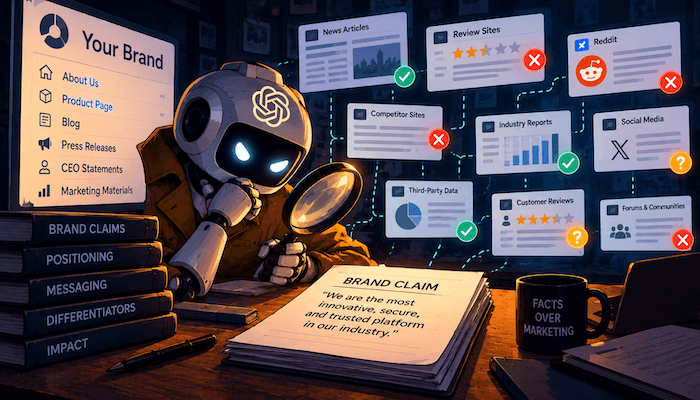
Most product pages are full of claims nobody can check from the page itself. “Industry-leading.” “Trusted by thousands of teams.” “The fastest way to get started.”
For a human skimming the page, that copy at least sets a tone. For an AI system deciding what to say about your brand, a claim with nothing beside it gives very little to work with.
In June 2026, the communications agency Burson published The Credibility Paradox, built with the AI marketing platform Profound. The report covered more than 55,000 believability scores across 85 companies and seven AI answer platforms, and its central finding was that answers backed by observable proof scored higher than answers built on corporate positioning.
A week later, Semrush and Kevin Indig found that 61.7% of AI citations never mention the brand being cited. That leaves brands facing two separate problems: getting AI to trust what they say, and getting AI to name them when it uses their content.
Both problems point to the same piece of work. Specific, verifiable proof needs to sit right next to the claims that matter most.
What the Research Says About Evidence and AI Answers
The strongest academic evidence comes from the paper that coined the term Generative Engine Optimization (GEO). Researchers from Princeton, Georgia Tech, the Allen Institute for AI, and IIT Delhi tested content changes across roughly 10,000 queries, and presented the work at KDD 2024.
Adding quotations, adding statistics, and citing credible sources produced the largest gains, lifting visibility in generated answers by up to 40%. Keyword stuffing offered little to no benefit, and simply writing in a more authoritative tone didn’t help much either.
The most interesting result involved smaller sites. When a page ranked fifth in traditional search added citations to credible sources, its visibility in generated answers rose by 115.1%, while the top-ranked page in the same test actually lost visibility.
That study used a controlled benchmark and the AI engines of 2023, so treat the numbers as direction rather than a promise. More recent data points the same way.
Semrush analyzed more than 300,000 URLs cited by AI platforms and compared them with similar pages that weren’t cited. Cited pages were 32.83% more likely to include clear summaries and easy-to-scan takeaways, and 22.91% more likely to have strong section structure.
The same research found a 30.64% correlation between AI citations and stronger signals of experience, expertise, authoritativeness, and trustworthiness (E-E-A-T). The practical fixes it recommends are author bios that explain relevant experience and reliable source links beside key claims, especially numbers and strong statements.
Burson’s report adds the audience side. Fact-based claims about products, innovation, and workplace practices proved more believable than claims in subjective areas, and leadership was the hardest category to make credible.
One caveat on Burson, which Search Engine Journal flagged in its coverage: the agency sells reputation and GEO services, and the scores came from a model Burson built itself. Still, three studies using different methods arrive at the same conclusion about specific evidence.
Why Getting Cited Doesn’t Mean Getting Named
The second problem is the one most AI visibility dashboards hide.
Semrush and Kevin Indig analyzed 3,981 domain appearances across 115 prompts, 14 countries, and four AI experiences: ChatGPT, Gemini, Google AI Overviews, and Google AI Mode. They called a citation without a brand mention a “ghost citation,” and 61.7% of citations fell into that category.
Only 13.2% of all appearances included both a citation and a brand mention. The platforms also behaved very differently from each other.
ChatGPT cited the domain in 87% of appearances but named the brand in only 20.7%. Gemini almost reversed that pattern, naming brands in 83.7% of appearances while citing a source only 21.4% of the time.
Prompt shape mattered too. Short, conversational questions produced far more brand mentions, while long, detailed prompts triggered more citations and fewer mentions.
This has a direct consequence for how you add evidence. A generic industry statistic on your page can earn a citation as a source of facts while doing nothing for your name, because the fact an AI lifts carries no connection to your brand.
Proof about your own product works differently. A named customer result, your own benchmark, or a review of your specific tool ties the fact to your name, which gives the model a reason to mention you when it uses the information.
That’s an inference rather than something the study directly tested. It does follow from how the two outcomes split apart, and it’s why the strongest proof points are specific to you.
What a Credibility Nugget Actually Looks Like
Some marketers now call these proof points “credibility nuggets.” The label matters less than the format: a short, specific piece of evidence placed directly beside the claim it supports, with a link to the original source.
A sourced statistic. Link to the original research rather than a roundup post quoting it secondhand. If the number came from a vendor survey, say so.
A customer result with a name and a number. “Customers love us” says nothing. A named company, a measurable outcome, and a link to the full case study gives both readers and AI something to verify.
An independent review or rating. Link to the actual G2, Capterra, or Trustpilot page rather than pasting a quote with no source attached.
An award or certification. Link to the awarding organization’s page, since a badge image on your own site can’t be checked by anyone.
Original data you collected. State how you gathered it, the sample size, and when. Your own research is the hardest proof for competitors to copy and the easiest for AI to attribute to you.
Here’s what the rewrite looks like in practice, with placeholders for your own real figures:
Before: “[Product] is the leading solution for faster onboarding.”
After: “[Customer] cut new-hire onboarding from [X] weeks to [Y] weeks after switching to [Product], according to [linked case study].”
If you can’t fill those placeholders with something real and checkable, that tells you something important about the original claim.
Placement matters as much as the proof itself. Evidence needs to sit in the same paragraph as the claim it supports, rather than in a testimonial carousel at the bottom of the page or on a separate case studies page three clicks away.
Consistency matters too. If your page cites a customer result that contradicts what independent review sites say about you, the mismatch can work against you, which is why on-page proof and off-site corroboration need to tell the same story.
How to Audit Your Pages for Verifiable Proof
Start with your highest-stakes pages: product pages, comparison pages, and use-case pages that influence buying decisions. This process works one buyer question at a time.
Pick one buyer question tied to revenue. Choose something a prospect would actually ask an AI assistant, like how your product compares with a named competitor or whether it fits a specific use case. Avoid broad informational topics for this first pass.
See what AI currently cites for that question. Note which pages appear as sources, which brands get named, and which third-party sites keep showing up. Those third-party sources tell you what the AI already treats as credible in your category.
List every claim on your page that answers the question. Mark each one as supported, partially supported, or unsupported. Most teams find that their strongest-sounding claims have the least evidence behind them.
Fix or cut the unsupported claims. Add proof where you have it, and rewrite the claim down to what you can actually support where you don’t. A modest claim with evidence is more useful than a bold one without it.
Put the direct answer near the top of each section. Given Semrush’s finding on clear summaries, lead with a one or two sentence answer, then follow with the supporting proof.
Close the independent coverage gaps. If the cited sources include review sites or publications where your brand is absent, those become your outreach and review-generation priorities.
Track citations and brand mentions separately. Watch both for several weeks after the update. Adding proof points doesn’t guarantee a citation, but tracking tells you whether the work changed how AI describes you.
Where the Semrush AI Visibility Toolkit Fits
Steps two and seven are where most teams stall. Pasting prompts into ChatGPT one at a time gives you a snapshot, but it can’t show you patterns across dozens of buyer questions or how answers shift after you update a page.
The Semrush AI Visibility Toolkit covers both of those steps, and each part maps to a specific stage of the audit.
Prompt Research shows the questions people actually ask AI platforms in your category. That means your audit starts with real buyer prompts instead of the questions your team assumes buyers ask.
Prompt Tracking monitors your chosen prompts daily, and its Sources view shows the cited pages and third-party sources behind each answer. That list does double duty, telling you whether your updated page starts earning citations and which outside sites AI already trusts in your category.
Brand Performance shows how AI platforms describe your brand, including share of voice, sentiment, and the narratives attached to your name. This is where you can see whether the AI’s description of you rests on specifics or on vague positioning, and whether competitors are described with more concrete proof.
Visibility Overview benchmarks your mentions and citations against competing brands over time. Because it tracks the two separately, it shows directly whether you have a ghost citation problem, with your pages cited but your name absent.
Competitor Research surfaces the prompts where competitors get named and you don’t. Those prompts are usually the best candidates for your next proof-focused page update.
The toolkit costs $99 per month per domain on annual billing. That covers AI visibility reports for any domain, 25 custom prompts tracked daily, Brand Performance for one domain, mentions across ChatGPT, Google AI, Gemini, and Perplexity, competitor analysis, prompt research, and a site audit for AI readiness.
The standalone toolkit doesn’t currently list a free trial. If you’d rather test before committing, the SEO + AI Search plans include AI visibility tracking and come with a free trial.
Explore the Semrush AI Visibility Toolkit
Final Thoughts
Marketing copy has always leaned on claims nobody checks closely. AI systems read differently, and the research so far suggests they favor content where the evidence sits right beside the statement it supports.
The useful shift is treating every important claim on a page as something a skeptical reader might want to verify on the spot. If the proof is there, linked and specific, both human buyers and AI systems have a reason to trust it.
None of this guarantees a citation or a recommendation. What it does is make your pages more useful as a source, and when the proof is specific to your brand, it gives AI a reason to say your name when it uses what you’ve published.