

Full disclosure: This post contains affiliate links. If you make a purchase through these links, 99signals may earn a commission at no additional cost to you.
Publishers have spent three years making the same complaint about AI search. Google extracts value from their content, generates answers with it, and sends back fewer clicks every quarter.
Google is finally testing a response, and this one comes with money attached.
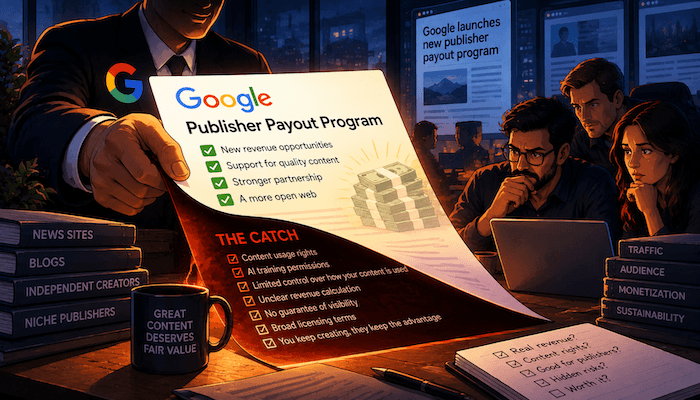
On September 14, Digiday reported that Google has been quietly running an “AI contribution pilot” inside Search Console. It pays publishers when their content significantly shapes AI-generated responses in Gemini, AI Overviews, and AI Mode.
Barry Schwartz had actually spotted the feature back in April. There was no sign money was involved, so he assumed it belonged to the AI performance reporting rollout.
What makes this more than industry trivia is who Google is approaching. Digiday found the pilot has been far more appealing to small and mid-sized publishers than to large media companies, and that it has expanded well past news sites.
That describes most independent publishers, this one included. The opt-in question is going to land in a lot of inboxes over the next year.
What Actually Triggers a Payout
The mechanics are narrower than the headlines suggest, and that narrowness is the real story.
Google’s help documentation, which Digiday obtained and published as screenshots, says publishers earn when their content contributes significantly to AI-generated responses. The word doing the work is “significantly.”
Payment applies only at the generation stage, where your content actively shapes what the response says. Anything happening after the answer exists falls outside the program.
Content linked within a finished response doesn’t qualify. Content used to verify a fact after the answer is written doesn’t qualify either.
That rules out the most visible form of AI exposure publishers currently track. Showing up as a citation link beneath an AI Overview, the thing every GEO dashboard is built to measure, is not by itself a paid contribution.
Your content has to have influenced the substance of the answer while it was being assembled. That’s a process no publisher can observe from the outside.
Nobody Knows How Google Calculates This
Publishers who accept the terms get an AI earnings widget in Search Console showing a monthly figure with some running history.
That’s the entirety of what they can see.
There’s no breakdown by article, no view into which queries generated the earnings, and no methodology document. You cannot connect a dollar to a page, which means you cannot audit the number against anything.
One executive familiar with the program told Digiday it was “quite black box.” Another source described early payouts as small next to ad revenue.
Schwartz offered a reasonable counterpoint. Google is almost certainly still working out how to value content contribution to a generated answer, and that’s an unsolved problem across the entire industry.
Both readings hold up. The opacity might be an honest symptom of a hard measurement problem rather than a structure for underpaying.
But a publisher deciding whether to accept has no way to tell the difference from where they’re standing.
Declining the Money Doesn’t Stop the Usage
There’s a mechanical detail buried in the coverage that could cost you real traffic if you get it backwards.
Opting out of the payment pilot and opting out of AI grounding are separate controls.
Search Console now lets a verified property decide whether its content can appear in or ground AI Overviews, AI Mode, and generative AI features in Discover. Flipping that switch means surrendering whatever impressions and referral clicks those surfaces currently send you.
Google has said the choice isn’t used as a ranking signal for non-generative Search. The AI-surface traffic goes regardless.
The contribution pilot is a different switch entirely. Leaving the payment program doesn’t pull your content out of AI features, and joining it doesn’t grant Google access it didn’t already have.
Refusing the money and refusing the usage are independent decisions. Declining payment protects nothing.
Your content grounds AI responses either way unless you separately opt out of grounding. And opting out of grounding costs you traffic to prevent a use you weren’t being paid for anyway.
Why Some Publishers Are Saying No
The criticism Digiday surfaced deserves a hearing even if you take the money.
The argument is that accepting formal payment converts an ambiguous situation into a consented one. Publishers currently arguing that AI systems extract value without compensation have a live grievance, and in some jurisdictions, standing behind it.
A publisher who has signed program terms and banked the payments has a weaker version of that argument. Critics quoted in the reporting called the program a legal fig leaf rather than meaningful compensation.
The leverage question splits hard by publisher size. Large media companies can negotiate bespoke licensing deals, the model OpenAI has pursued with major news organizations.
Google has conspicuously avoided those lump-sum arrangements in favor of this programmatic approach.
Independent publishers have no equivalent leverage. The terms are simply the terms.
That asymmetry probably explains why Digiday found smaller publishers more receptive. When you have no standing to negotiate, an opaque payment still beats nothing.
How to Benchmark Before You Opt In
Nobody outside the pilot has enough information to say confidently whether joining is correct. The methodology isn’t public, reported amounts are small, and the legal implications vary by publisher.
What you can control is whether you walk in with data.
The core problem is that a monthly earnings figure with no context is a number you can’t evaluate. If Google shows you $340, the only useful question is whether $340 is reasonable given how much your content actually grounds AI answers.
That question is unanswerable unless you were already measuring. The baseline has to exist before the widget does.
This is why I’d have measurement running before any invitation arrives, and the Semrush AI Visibility Toolkit is the setup I’d use.
The Visibility reports track citation frequency and trends on Google AI Mode, then let you hold that against ChatGPT, Perplexity, and Bing in the same view.
That comparison matters more than it first appears. Google is the only one of those platforms offering to pay you anything.
If Google AI Mode accounts for a fifth of your AI citations, a payment covering that fifth reads very differently than one covering most of them.
The Citations reports give you the URL-level detail Search Console’s widget withholds. You can see which pages get cited, which grounding queries trigger them, and how counts break down by platform.
That’s the closest observable proxy for where your content sits in the answer pipeline. If a handful of pages are doing most of the grounding work, you know which assets the payout should be tracking.
Prompt Research and Tracking covers the other half. You monitor a set of priority prompts over time and watch how visibility moves.
That matters after opting in. The obvious concern with formally consenting to AI usage is whether anything shifts afterward, and without tracked prompts running before and after, any change you notice is just anecdote.
Position Tracking handles the traditional side, showing which keywords you rank for in AI Overviews so you can watch for divergence between organic and AI presence.
The toolkit runs $99 per month per domain on annual billing. That covers AI visibility reports, 25 custom prompts with daily rankings, brand performance analysis, mentions across ChatGPT, Google AI, Gemini, and Perplexity, competitor and prompt research, and an AI readiness site audit.
Given that the decision involves accepting an unverifiable payment against an unmeasured baseline, three to six months of citation history is worth more than the subscription costs.
Start tracking your AI visibility
The Bottom Line
The AI contribution pilot is the first real acknowledgment from Google that content powering AI answers might warrant direct payment instead of a vague promise of traffic. That carries weight independent of the size of the checks.
What’s being tested, though, asks publishers to accept an undisclosed payment calculated by an undisclosed method. In exchange, you formally consent to a use that was already happening.
Whether that’s a good trade depends on numbers Google hasn’t released and consequences that won’t be legible for years.
For most independent publishers the pragmatic answer is probably yes. Declining doesn’t buy protection from AI usage, it buys the identical usage with no payment attached.
The grounding opt-out is a genuine alternative, but pulling that lever means forfeiting referral traffic to stop a use you weren’t compensated for regardless.
What’s worth insisting on is not making the call blind. When the invitation lands, the publishers in the strongest position will be the ones who already knew what their AI visibility looked like before a dollar figure showed up in their dashboard.
Related Articles